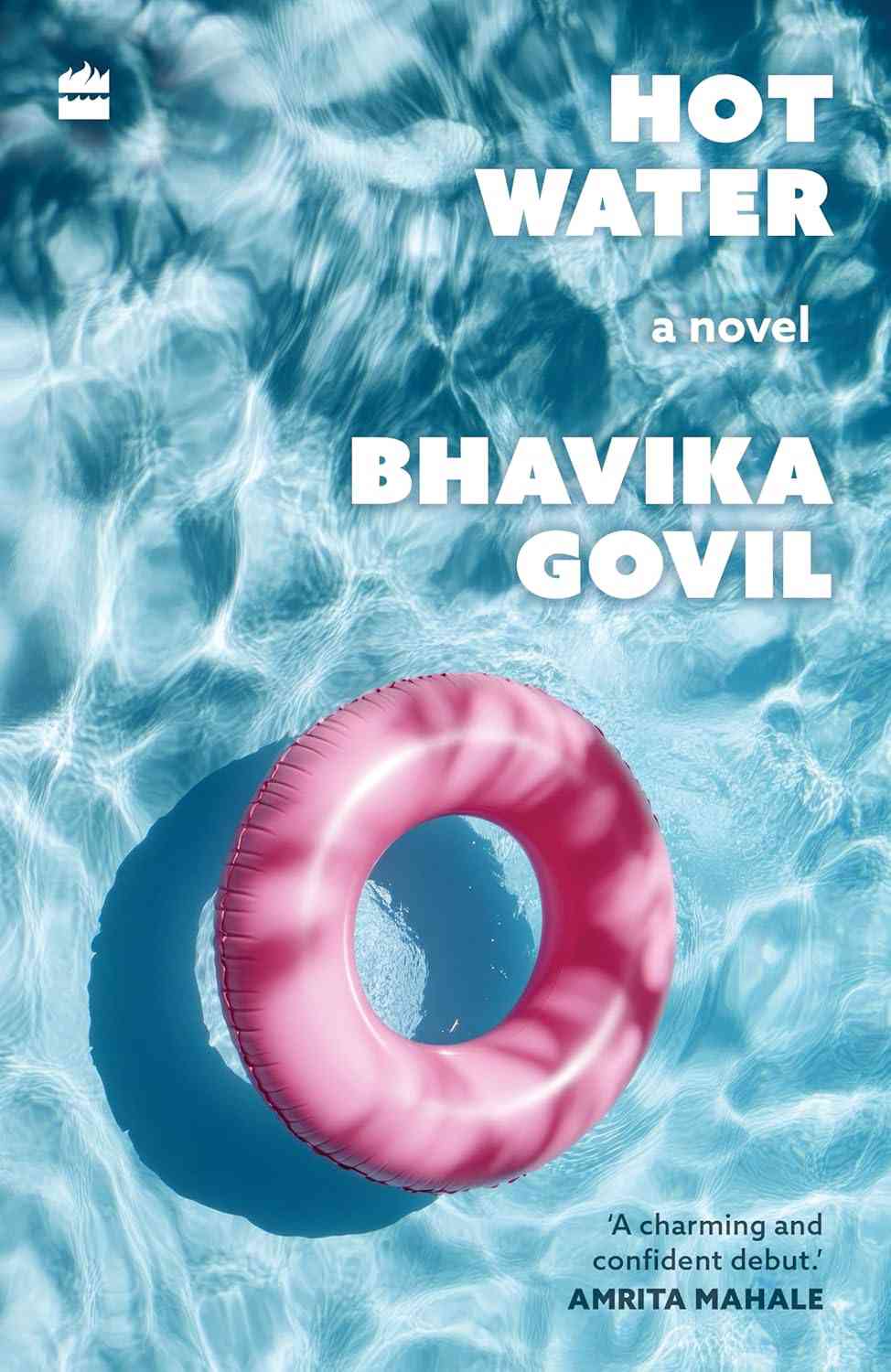



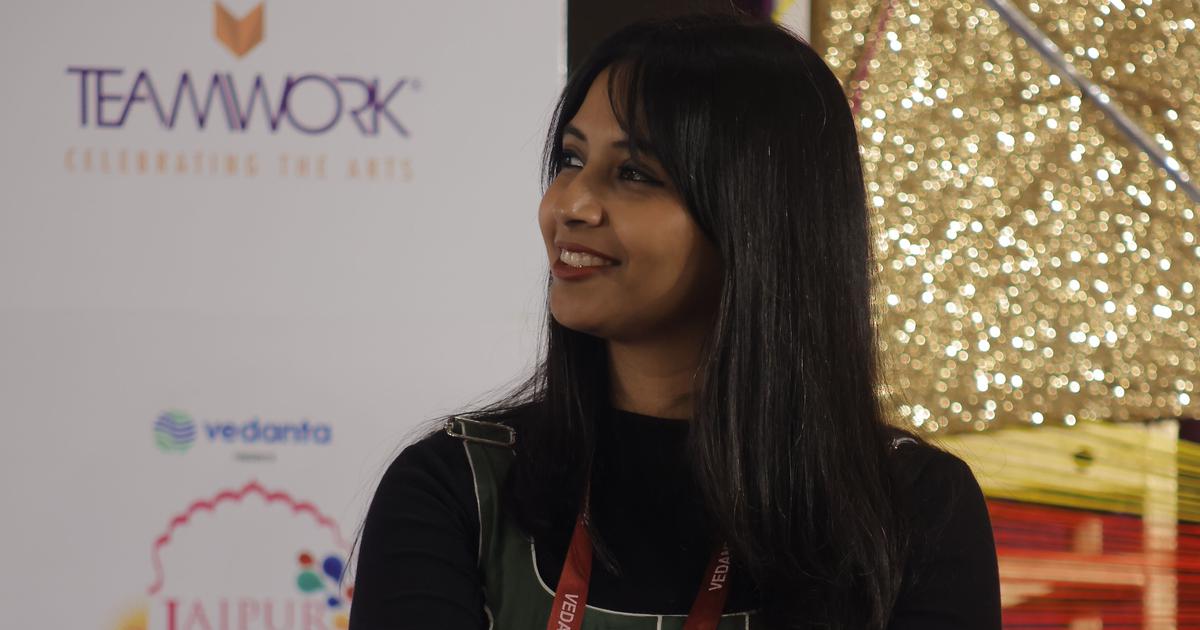
Bhavika Govil’s debut novel, Hot Water, circles a family of three – nine-year-old Mira, 14-year-old Ashu, and Ma. It is summer holiday and the days pass by merrily singing Simon and Garfunkel in Ma’s sun-yellow car, watching TV on the sofa, and taking a holiday to a mango orchard. Yet, beneath this tale of proximity lurks another story – that of a family in hot water.
Published by HarperCollins India in 2025, Govil’s novel was shortlisted for the Godrej Literature Live! First Book Award. It is forthcoming in the UK and has already been translated into French. Her short fiction has appeared in Granta, Wasafiri, Extra Teeth, A Case of Indian Marvels, and elsewhere. She has won the Bound Short Story Prize, been shortlisted for the Queen Mary Wasafiri New Writing Prize, and longlisted for the TFA Awards for Creative Writing.
Hot Water stands out in its ability to empathise with children. Govil displays a remarkable ability to map their emotions – the reader instantly feels protective of Ashu and Mira. She is sensitive to how quickly the tides of puberty and adolescence change a child, and how fiercely they try to hold on to the remnants of innocence.
In a conversation with Scroll, Govil spoke about why the summer is essential to her novel, juggling the short story and novel forms, teaching creative writing to young writers, and more.
The children are almost desperate to have a “normal” mother. The father is largely missing from their lives. The pressure to be “normal” is as monumental as it is unfair. While you were writing the book, what did you think could be the reason why children seek total discipline from a mother?
When you are a child, you make up good… and bad things. In Hot Water, the father is a figment of the children’s imagination. They don’t remember meeting him, and a handful of anecdotes about him exist and circulate in the house, and have become lore in themselves. The mother refuses to speak about him, and so the children often use their imagination, which is plentiful – and the scraps of information offered to them by Ma, to fill in the gaps in the story and also make up an ideal version for the father.
But what’s in front of them is real and imperfect – it’s the mother, whose attention the two children, Mira (8) and Ashu (14), fight and clamber for, sometimes to no avail. She’s sharp, sometimes feral, protective of the two cubs, yet aloof. Her temperament fluctuates between Moth Days and Butterfly Days, and neither Ashu nor Mira knows when they’ll get which version of their mother.
Whereas around them are versions of other mothers – those that don’t respond with an expletive to a rude driver on the road, that keep a watchful eye on their kids during swimming lessons at all times, that would never go for dinner with another man, and who are just more “normal”, in the context of Indian society. With the father absent, the balance in this family is warped. A great deal falls on Ma, who is raising two children by herself while contending with her own ghosts.
How does one write about the cruelty that children are capable of without villainising them?
Being a teenager in an adult’s world is one of the most terrifying stages one encounters on the way to growing up. At that age, you’re still contending with the idea of who you are and how you wish to be. Amplify that with two hundred other children going through the same thing at school. Sometimes, things aren’t great at home, and even if they’re alright, you’re experiencing something tremendous regardless – a bewildering coming of age.
That change can make children sensitive and prickly, capable of inflicting surprisingly piercing cruelty, without fully realising what the consequences of that might be. I saw it often at school: bullies who got a particular kick out of making fun of the less popular one, the overweight one, the quiet one. Even silence, not choosing to stand up for someone, can be a form of cruelty.
As a writer, however, you’re always aware of what a character thinks and where their actions stem from. Once you understand their inner world, their insecurities and their backstory, you’re unable to villainise them. That was important to me in the novel. Characters like Ishan or Avni may be capable of hurtful behaviour or words, but they aren’t just antagonists.
I’ve even met some of the children I went to school with years after, and although I’m not sure they possess full self-awareness about their past actions, they seem to have mellowed over time. That possibility of growth is real.
Why is only Ashu given a third-person voice? I read it as him being the other in some ways in a family of women. And of course, Ashu is yet to arrive at his own personhood. What was your thinking?
It would be cocky to think I had anything to do with it, you know? Each of the characters in the novel seemed to arrive with their own language and ways of expressing themselves, and I had to acquiesce. Ashu, who is the reticent 14-year-old boy in the novel, often finds himself at a loss of words. He’s the more reserved and restrained presence in his family, leaving the question marks and extended monologues to his sister, Mira, and their Ma.
When I began writing Ashu, I had assumed that I would write him in the same manner as the other two characters in this polyphonic novel, that is, in the first-person voice. But I kept running into a roadblock. It became extremely difficult for me to inhabit Ashu’s personality authentically, to find his tonality and interior world through a first-person voice, which can often demand intimacy and a knowing of oneself.
Finally, it is only when I shifted to the medium of the third-person narrator for Ashu that I arrived at a door which led me to Ashu’s inner world and unlocked his voice. From that slight distance, I could now see his character more clearly, his loneliness, his understated wit, his friendship with Rahul, his surreal, vivid dreams, the first stirrings of desire, and the intense, inexplicable dislike he feels radiating from his mother. In other words, his inner world became fully realised.
This narrative distance turned out to be crucial – not only to arrive at Ashu’s voice but for the balance of the entire novel.
Mira’s voice reminded me of nine-year-old Swiv in Miriam Toews’s remarkable novel Fight Night. How did you arrive at her voice?
At the precipice of writing Hot Water, I had a choice – should I write Mira as an adult reflecting on one important summer in her life, or as the child herself, experiencing and narrating events as they unfolded? I decided rather quickly, and somewhat against common advice, to inhabit the child narrator and to write in the language of an eight-year-old girl in an adult novel. I wanted the immediacy of the child’s voice, and using an adult retrospective narrator would have diffused some of the tension in the narration.
I began to experiment with her syntax and how she’d describe things and play with language. Mira was the kind of character who’d wonder if a wintersault would be the opposite of a somersault, and who’d describe babysitting as a morbid act of adults sitting upon ugly babies. She’d observe the unsettling undercurrents in the room between her mother and her brother Ashu but not be able to articulate what was wrong. As a writer, I enjoyed that the adult reader might be able to piece together what was happening in the story, even when Mira couldn’t quite understand the threat or danger around her.
Practically speaking, I also revisited journals I’d written in when I was about eight or nine years old to see how children actually spoke and thought. I have to admit that my imagination was far less inventive and exciting than Mira’s was at that age, for there’s an entry where I obsess entirely about India’s loss to Australia in the 2005 World Cup. Although Mira and the events in her life are fictional, perhaps by writing her, I’ve taken parts of me that were unlovable as a child and convinced you that they were cute.
Child narrators are special little tyrants in fiction. Precocious, occasionally annoying, but deeply lovable. I’d love to imagine Mira in conversation with Jack from Room, Scout from To Kill a Mockingbird, or Jai from Djinn Patrol on the Purple Line. What chaos shall ensue?
Also read:
‘Hot Water’: Bhavika Govil’s debut novel movingly constructs a child’s fragile yet resilient world
Also, Hot Water is a very summer novel. You can feel the heat and the stuffiness. Why did it feel important for the story to unfold over the course of a summer?
Hot Water is a novel about a close but guarded family whose fate begins to change when the children begin swimming lessons. The novel unfolds over one long summer, where it’s so hot sometimes that “it feels like we are sitting inside the sun”, as one of the characters, Mira, puts it. Bees sink to the bottom of the swimming pool, the taps gush out burning hot water, mangoes are sliced and devoured, the fan whirs and groans, and the gulmohar tree outside their house turns from a pleasant orange to a violet red, ready to burst open. In essence, it’s summer in India.
I’ve always, somewhat unpopularly, been a summer person. While others shrink and hide in their air-conditioned rooms, I feel lighter in the heat, almost a new person. As a child, especially summertime felt liberating to me. During school time was not yours, but suddenly in the summer holidays, it was endless. You were free. Even though you were under your parents’ roof, there were long, unaccounted hours. You could make friends; you make secrets, keep them, break them.
Summer is also a potent time in literature – where secrets simmer and things get slightly unhinged in the heat. I often think of that unbearably hot day in The Great Gatsby, where things start to unravel. Or the languorous summer in Italy in Call Me By Your Name. There’s an intensity and freedom particular to the season. In Hot Water too, as the humidity increases, the secrets in the air thicken and threaten to upend life for the family forever. The long, hot summer in the novel actually took me five years to write. Time kept looping around itself, until I felt like I, too, was trapped inside an endless hot summer.
Many of us read your short stories before we read Hot Water. Between the two mediums, where do you feel more at home? Were you working on a novel alongside your short fiction or did a short story eventually take the form of a novel?
You are the first person to ever ask me this, but you are right – Hot Water did begin as a short story. In fact, the first sentence in the novel: “When I asked Ma why volcanoes erupt, she told me they had a tummy ache and had to belch all the lava out, thick, hot and molten…” is now in Mira, the eight-year-old narrator’s voice. But in the original story, it was told from the point of view of a mother.
Although years passed after I wrote the short story, I couldn’t shake off the feeling that there was something more to it. I chased that feeling in the summer of 2020, and it eventually became Hot Water. By that point, I had written around ten short stories. Some had started getting published in journals and being shortlisted for prizes. I wouldn’t say that I was particularly skilled at the form, but I had a sense of how to delve into character and understood the internal mechanics of writing short stories.
I had hoped that might help me with the novel, but the novel turned out to be an entirely new beast. There was architecture to consider, multiple plot strands, how they might interweave, and understanding the larger shape of a story. Before long, I was consumed by it. I kept writing myself into corners that I had to find a way out of.
In a way, though, I resist the idea that a writer must choose between the short story and the novel. I tend to write them simultaneously, not consciously favouring one form over the other. I recently published a short story, Folding Your Mother, on Granta, and Hot Water is coming out in different territories and languages this year. I’m also working on something longer; it’s early days, but I’m playing with it. Ideally, I’d love to publish a short story collection and a novel at the same time and have them both taken seriously. Must I choose?
Tell us about your creative writing course, Short Story Starter Kit. Why did you want to start teaching so early on in your writing career and what are some exciting things you’ve noticed that young writers are interested in?
As an emerging writer, I’ve been deeply shaped by my writing community, both in the formal classes led by professors that I attended while I was pursuing an MSc at the University of Edinburgh and through the informal workshops that my peers would conduct, some of whom were quite young but whose insights were illuminating. I wanted to create something similar myself.
I actually began teaching when I was in the middle of edits for Hot Water. About 40 people signed up for an online class. It was just brilliant. We read and wrote together, and the feedback was generous and constructive. After years of writing my novel alone in a closed room, I was so energised by the community, even online, that I ended up writing myself after the class ended. It was a great way to connect with writers. Then I devised the Short Story Starter Kit, which is an online four-week course in which we read, write, and hopefully, fall in love with the short story form.
Then there’s also the practical side of things. As a writer, I want to keep writing and have enough money to support it. I hope for these two things to be complementary. Running independent workshops, along with other freelance work, has helped me sustain my writing in a small but meaningful way.
As for the question about what writers are writing these days, I think most new writers are simply searching for their voice. What someone writes in their early stories is often an amalgamation of everything they love to read, so in class, I often see a fair mix of literary fiction, family stories – especially about mothers– and speculative stories. It’s exciting to watch how these voices will develop and shapeshift over time. As for younger writers, I recently judged a writing competition at IIT Delhi, where many participants were aspiring ship engineers and aeronautical engineers, but also creatives. I was happy to see their interest in reading and writing alongside engineering. I noticed that there was some curiosity towards a genre called romantasy, which I can’t say I’ve read yet.